Integrating dynamic media elements into interactive lessons allows educators to transform passive content consumption into active, relational conceptualization. Building on the interactive Google Sites framework from my Blog Post #2 and the multi-modal universal design scaffolds from Blog Post #3, I selected the Khan Academy Scale of Earth and Sun Video to explicitly expose textbook size distortions. Educational alignment requires that learning tools directly reinforce our target curricular fusion: bridging BC Science 6 celestial scale concepts with Math 6/7 geometric spatial reasoning.
Inherent and Learner-Generated Interaction (Prompts 1 & 2)
The video relies heavily on relational, mathematical scales. This structure lacks immediate inherent interaction because the raw broadcast format does not halt playback to demand student inputs. To bypass this baseline constraint, the video functions as a catalyst for learner-generated interaction. Middle school students can naturally pause the stream, sketch physical diameter line-ups, and make comparative notes. Bates (2022) explains in Teaching in a Digital Age Chapter 10.6 that an educational video’s real pedagogical power lies in its capacity to challenge structural mental models. It forces learners to actively process real-world spatial configurations rather than consuming data passively.
Post-Video Extension and Formative Feedback (Prompts 3 & 4)
Following the media segment, students complete a digital follow-up task titled “Ranking the Planets.” Using the interactive tools on the Google Sites platform, students apply mathematical scale factors. They transform planetary dimensions into local, regional, and national units, comparing various sizes building up to ratios used against the landmass of Canada. This applied task matches the frameworks explored by Kaur (2026). Her work proved that pairing focused instructional video clips with contextual data tracking anchors abstract mathematical relationships to realistic concrete frameworks.
To evaluate this task, students would receive feedback through interactive real-time marking; Google Sites allows for preset answers to be given based on the outcome of the learner’s interaction. These results can then be recorded for future reference. This medium allows peers to review each other’s spatial understandings and identify scaling anomalies, while an instructor can provide immediate feedback on spatial calibration errors referencing the results of the preset answers.
Inclusive Design and Spatial Accessibility (Prompt 7)
To address systemic learning barriers, the video is wrapped in a multi-modal delivery structure. The framework includes native closed captions, variable playback speeds, and a complete text transcript. These adjustments decrease working memory stress. They provide critical pacing flexibility for students building foundational mathematical competencies. By providing these forms of accessible pathways, my module would be able to accommodate human variability natively and eliminate the need for retroactive learning adjustments.
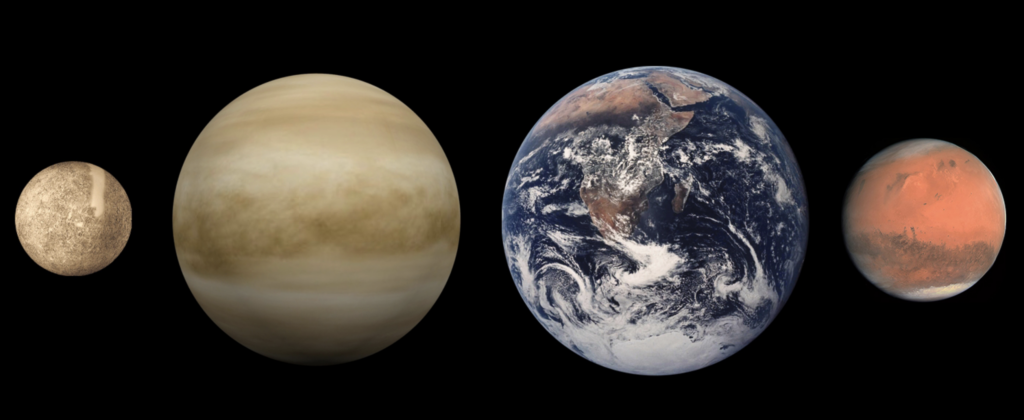
Figure 1
Terrestrial Planet Size Comparisons.
Note. From Wikimedia Commons Asset Landing Page. In the public domain.

References
Bates, A. W. (2022). Chapter 10.6: Interaction. In Teaching in a Digital Age (3rd ed.). BCcampus. bccampus.ca
Kaur, M. (2026, June 20). Blogpost 4 : Using Video for Interaction. Manveen Kaur’s EDCI 335 Blog. https://manv.opened.ca/blogpost-4-using-video-for-interaction/
Khan Academy. (n.d.). Scale of Earth and Sun [Video]. Cosmology and Astronomy. khanacademy.org
NASA. (2006). Terrestrial planet size comparisons [Digital graphic]. Wikimedia Commons. wikimedia.org
Recent Comments