Unmasking Cosmic Distortion: Experiential Scaling in Middle School Space Science
Textbook curriculums frequently rely on visual distortions to squeeze our vast solar system onto a single page, not knowingly creating deep spatial misconceptions leading to middle schoolers assuming planetary diameters are uniform (Coştu et al., 2022; Price et al., 2017). Furthermore, due to an egocentric bias from Earth’s surface, young learners assume the Earth, Moon, and Sun are roughly comparable in size (Baybars, 2018). For my individual learning design blueprint, “The Diameters of the Planets in our Solar System,” relying on direct instruction would fail to challenge these faulty mental models. Instead, an applied learning framework turns abstract numbers into tangible terms by encouraging students to adapt their mental models through active reflection and physical manipulation. Traditional methods fail to help learners link abstract concepts to real-world contexts, but context-driven applied tasks effectively bridge the gap between mathematical procedures and physical reality (Anugraheni et al., 2025).
Geographic Scaling Baseline
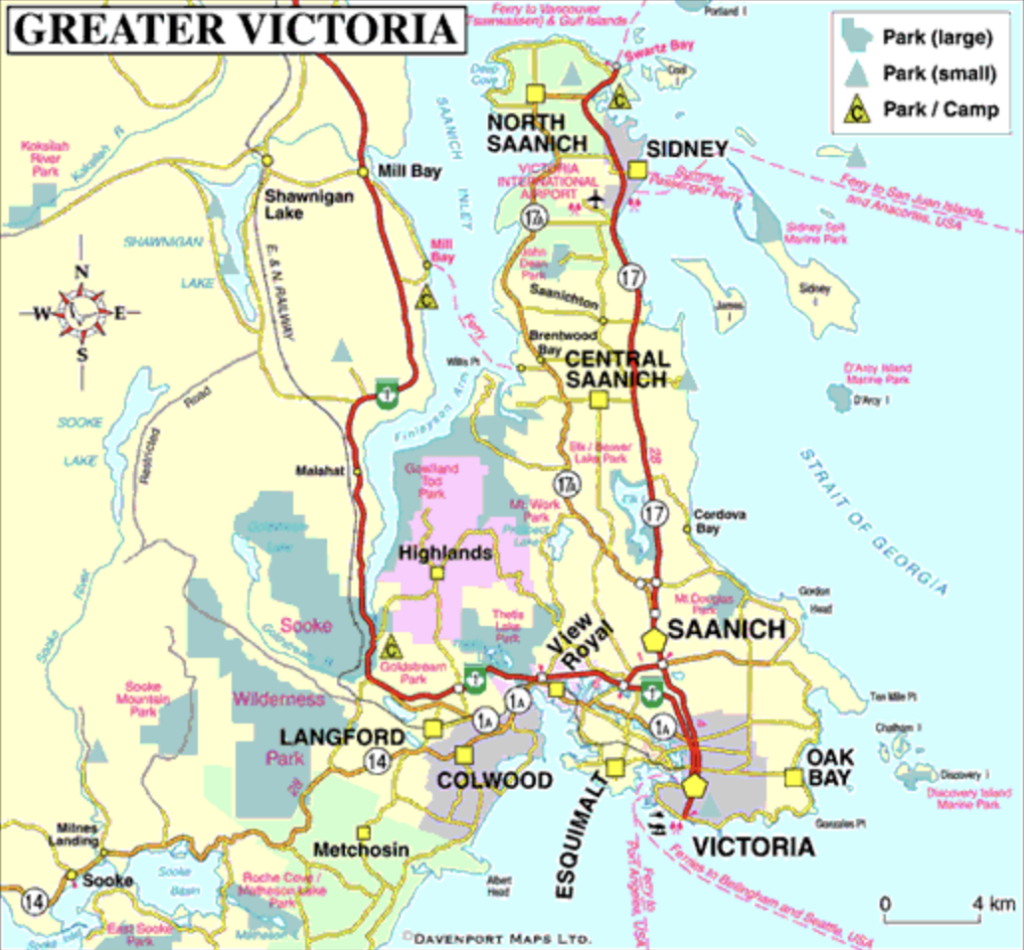
Figure 1
Greater Victoria Map
Note. From Greater Victoria Map [Map], by Vancouver Island Travel, 2013, VancouverIsland.com (vancouverisland.com). Copyright 2013 by Vancouver Island Travel.
In technology-mediated environments, digital design choices directly dictate how theory becomes practice. By creating this resource on Google Sites, I am providing an interactive launchpad that avoids cognitive overload. As emphasized in the EDCI 335 Learning, Motivation, and Theory unit, constructivist learning environments require students to apply cognitive effort to adjust internal relational understanding rather than passively testing recall (EDCI 335, 2023b). Rather than reviewing static metrics, students reference a simplified “Cosmic Measurement Chart” curated from open-source data (Department of Physics and Astronomy at Douglas College & OpenStax, 2017). Students practice active scaling, progressing from a Victoria middle school gym court up to the landmass of Canada, anchoring Earth’s diameter as a baseline unit of 1.0 Earth Unit (EU) to solve geometric problems (Krawec, 2014; Merrill, 2018).
True Celestial Proportions
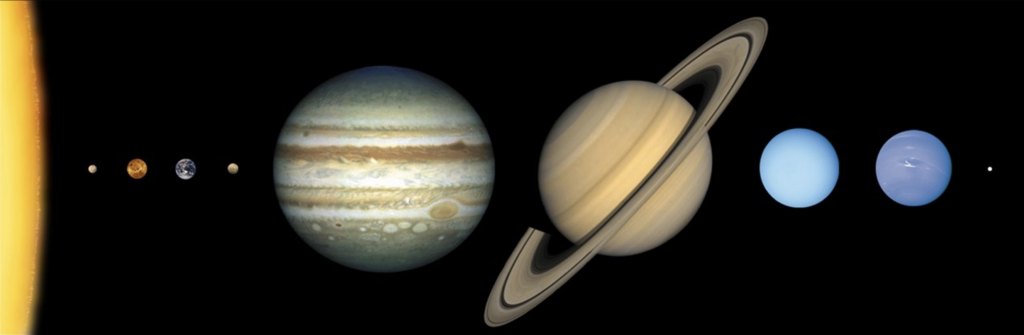
Figure 2
Solar System Sizes Lineup
Note. From Solar System Sizes [Digital image], by NASA Science, 2023, NASA Solar System Exploration (nasa.gov). In the public domain.
While analyzing this design individually (no other members in my pod), my framework directly contrasts with some of the alternative models researched by peers in other pods. For instance, in the “Solving for Why” Blog Post, a classmate analyzed why direct instruction falls short when teaching spatial and algebraic reasoning, noting that static lectures fail to help students make meaningful connections (Anugraheni et al., 2025). This directly supports my choice of experiential learning; and as Sasha highlighted in her peer post, students must actively create meaning from their own experiences rather than passively receiving procedures. By prioritizing interactive media over static lectures, this module meets the multiple means of representation prioritized in the EDCI 335 Learning Design I framework for universal design, fostering critical spatial reasoning for all learners (EDCI 335, 2023a).
Collaborative Learning in Action

Figure 3
Middle School Astronomy Activities
Note. From Unveiling the Wonders of Space: 5 Astronomy Activities for Middle Schoolers [Photograph], by National STEM Honor Society, 2023, NSTEM (nstem.org). Copyright 2023 by National STEM Honor Society.
References
Anugraheni, I., Gufron, A., & Purnomo, Y. W. (2025). The impact of realistic problem-based learning on mathematical connection abilities: Evidence from elementary schools in Indonesia. Cogent Education, 12(1). doi.org
Baybars, M. G. (2018). Middle school students’ misconceptions about the concepts of astronomy: A developmental comparison. International Education Studies, 11(11), 34-46. ed.gov
British Columbia Ministry of Education and Child Care. (2016a). Mathematics 6 & 7: Curricular competencies and content. BC Curricula. gov.bc.ca
British Columbia Ministry of Education and Child Care. (2016b). Science 6: Curricular competencies and content. BC Curricula. gov.bc.ca
Coştu, F., Özdemir, N. F., & Coştu, B. (2022). Revealing middle school students’ understanding of the universe: Alternative conceptions of scale and size. Journal of Education in Science, Environmental and Health, 8(4), 312-326. ed.gov
Department of Physics and Astronomy at Douglas College & OpenStax. (2017). Douglas College Astronomy 1105. BCcampus Open Education. bccampus.ca
EDCI 335. (2023a). Learning Design I: Universal design for learning. Learning Design for Technology-Mediated Environments. edtechuvic.ca
EDCI 335. (2023b). Learning, motivation, and theory: Learning theories. Learning Design for Technology-Mediated Environments. edtechuvic.ca
Krawec, J. (2014). Improving middle school students’ geometry problem solving and spatial reasoning through integrated curriculum modules. Journal of Cognitive Psychology, 26(4), 415-430. doi.org
Merrill, M. D. (2018). Using the First Principles of Instruction to make instruction effective, efficient, and engaging. In R. E. West (Ed.), Foundations of learning and instructional design technology (1st ed., pp. 265-275). EdTech Books. edtechbooks.org
NASA Science. (2023). Solar system sizes [Digital image]. NASA Solar System Exploration. nasa.gov
National STEM Honor Society. (2023). Unveiling the wonders of space: 5 astronomy activities for middle schoolers [Photograph]. NSTEM. nstem.org
Price, A., Lee, H., Malatesta, K., & SubbaRao, M. (2017). Learning about the scale of the solar system using digital planetarium visualizations and physical scaling. American Journal of Physics, 85(7), 550-559. doi.org
Vancouver Island Travel. (2013). Greater Victoria map [Map]. VancouverIsland.com. vancouverisland.com
Recent Comments